
If you are living with constant hip pain, stiffness while getting up from a chair, or a limp that is slowly stealing your confidence, you are not alone. In my clinic, many patients come with the same question: “Doctor, should I choose robotic hip replacement or traditional hip replacement?”
Let me make one thing very clear from the start: both options are performed by a surgeon. A robot does not operate on you by itself. In robotic hip replacement, the technology helps us plan the surgery more precisely and guides certain steps so we can match your hip anatomy more accurately. Traditional hip replacement is also a proven, reliable surgery, especially when done by an experienced joint replacement surgeon.
In this article, I will explain 10 practical reasons many patients prefer robotic precision, where it truly helps, where it may not change much, and what you should ask before deciding. I will also address common concerns like the cost of robotic hip replacement, recovery time for robotic hip replacement, disadvantages of robotic surgery, and even new treatment instead of hip replacement for patients who are not ready for surgery.
Is Robotic Hip Replacement Better? 10 Reasons It May Outperform Conventional Surgery:
1) A planned surgery, not an estimated surgery
Before we begin, we create a detailed plan for your hip replacement. This includes selecting the most suitable implant size, deciding ideal positioning, and setting clear targets for leg length and hip balance.
Why it matters medically: Hip replacement is not only about removing pain. It is also about restoring how your hip moves and how your body weight transfers while you walk. When we plan properly, we reduce the chances of small alignment errors that can later show up as discomfort, limp, or a hip that does not feel “right.”
Who benefits most:
- Patients with hip deformity, dysplasia, or old fracture-related arthritis
- Patients with severe stiffness where anatomy is difficult to judge during surgery
- Patients who are anxious about leg length difference
Note: In consultation, I always review your X-rays and, when needed, advanced imaging to decide whether robotic-assisted hip replacement adds meaningful value in your case.
2) Better control of cup placement, which directly affects stability
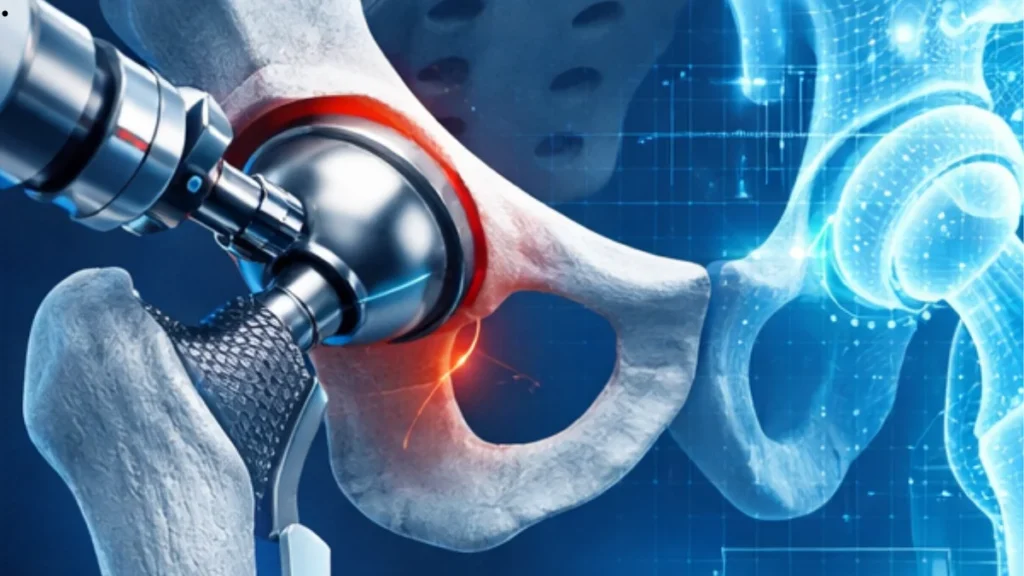
The acetabular cup (the socket implant) needs to be placed at the right angle and orientation. Robotic guidance helps us stay closer to the planned position.
Why it matters medically: Cup position is one of the biggest technical factors linked with stability and smooth movement. When cup placement is off, it can increase the chance of impingement (pinching), abnormal wear, and in some cases dislocation. This is why many patients searching for the newest method of hip replacement are actually looking for a method that improves accuracy and reduces variability.
Who benefits most:
- Patients at higher risk of instability
- Patients with spine problems or posture changes that affect hip mechanics
- Patients who want maximum confidence in implant positioning
Note: I explain cup positioning to patients in simple terms: the socket angle decides how comfortably and safely the ball moves in daily life like sitting, bending, and walking.
3) More reliable leg length control to reduce limp and back strain
Many patients worry: “Will one leg become longer after hip surgery?” With robotic planning and intraoperative measurement, we can target leg length more precisely.
Why it matters medically: A noticeable leg length difference can lead to limping, low back pain, pelvic tilt, and discomfort during long walks. Sometimes the body adapts, but if the difference is large, it can become a long-term complaint even after a technically successful surgery.
Who benefits most:
- Patients who already have back pain or scoliosis
- Patients with pelvic tilt or long-standing limp
- Patients who are very sensitive to imbalance in walking
Note: I tell patients the truth: the goal is equal legs and balanced hips, but safety and stability are always the first priority. In some complex hips, a tiny difference may be safer than risking instability.
4) Better restoration of hip offset for stronger, more natural walking
Hip offset is the natural side-distance that allows your hip muscles to work efficiently. Robotic planning helps us restore that geometry more accurately.
Why it matters medically: If offset is not restored well, patients may experience a persistent limp, weakness while climbing stairs, or pain on the outer side of the hip due to muscle overload. Many people think this is just “slow recovery,” but often it is a biomechanics issue. This is one reason some patients feel robotic hip replacement gives a more natural walking pattern, especially in the early months.
Who benefits most:
- Active patients who want strong gait and stability
- Patients with weak hip abductors
- Patients who had a long period of limping before surgery
Note: Your recovery time for robotic hip replacement still depends on physiotherapy and muscle rebuilding, but when biomechanics are restored well, rehab often feels smoother and more predictable.
5) Real-time feedback during surgery helps us make measured decisions
In robotic-assisted hip replacement, we do not rely only on visual judgment. The system helps confirm key targets like component position, leg length, and hip offset during surgery.
Why it matters medically: Hip replacement is a game of millimeters and degrees. A small change in cup angle or femur positioning can affect hip stability, range of motion, and even how your hip feels while sitting cross-legged or getting in and out of a car. Real-time feedback reduces uncertainty, especially in difficult hips where anatomy is altered by arthritis or old injury.
Who benefits most:
- Patients with severe osteoarthritis where the normal hip shape is distorted
- Patients with stiff hips and limited range of motion
- Patients who want maximum accuracy in implant placement
Note: I explain this to patients like this: in traditional surgery, we use our skill and instruments to achieve a good position. In robotic hip replacement, we still use skill, but we add data and guidance to reduce variability.
6) Consistency matters, especially when your case is not “simple arthritis”
Patients often assume every hip replacement is the same. In reality, every hip behaves differently based on bone shape, stiffness, spine posture, and muscle balance. Robotic assistance helps deliver a more consistent surgical execution compared to purely manual steps.
Why it matters medically: When your hip anatomy is challenging, small alignment errors can compound. That is when patients may complain later about discomfort at certain angles, a sense of imbalance, or persistent limp. Consistency becomes important when the surgeon needs to reproduce an ideal plan despite limited visibility or complex geometry.
Who benefits most:
- Patients with high body weight where exposure is technically harder
- Patients with hip deformity, dysplasia, or old fracture fixation
- Patients with very tight soft tissues and contractures
Note: Technology can improve consistency, but it cannot replace surgical experience. When you are comparing options, ask your surgeon about their experience with both robotic and traditional hip replacement, and how they decide the best method case by case.
7) More predictable early rehab because the hip balance is closer to natural biomechanics

Many patients report they feel more confident putting weight on the operated side early, especially when the hip feels balanced and stable. Robotic planning aims to restore that balance more precisely.
Why it matters medically: Early rehab is not only about wound healing. It is about rebuilding your gait and training your muscles to support a new joint. If your hip length, offset, and stability are closer to ideal, physiotherapy becomes more straightforward. You still need rehab, but fewer “compensation patterns” develop.
Who benefits most:
- Patients who had a long-term limp before surgery
- Patients who are fearful of walking due to pain history
- Patients who want a structured recovery path with milestones
Recovery time for robotic hip replacement: what I tell my patients
These are practical milestones I use in clinic, but your timeline depends on age, fitness, diabetes control, smoking, and how consistently you do physiotherapy:
- Day 1 to 2: standing and walking with a walker under guidance
- First 2 weeks: improved confidence in walking, stair training if safe
- Weeks 3 to 6: transition toward a cane for many patients, better stamina
- Weeks 6 to 12: stronger gait and more independence in daily activities
- 3 to 6 months: major strength recovery, longer walks become comfortable
- Up to 12 months: fine improvements in strength, flexibility, and endurance
Note: Robotic assistance may help the surgical accuracy, but your rehab discipline decides your final outcome.
8) It addresses common fears of people against robotic surgery with transparency
Some patients come to me saying, “Doctor, I do not trust robotic surgery.” Most of the time, this fear is based on misunderstanding. They imagine the robot is operating independently or making decisions.
Why it matters medically: Fear delays treatment. When hip arthritis becomes advanced, pain leads to poor sleep, low activity, and muscle wasting. The longer you limp, the harder the rehab becomes after any hip replacement. So I prefer to remove fear with facts.
Why people are against robotic surgery (and my honest answer):
- Concern 1: “The robot will operate on me.”
No. The surgeon performs the surgery. The robotic system supports planning and guides precision steps. - Concern 2: “It is experimental or unsafe.”
Robotic-assisted joint replacement is not a new experiment, but it is also not mandatory for every case. - Concern 3: “It is only marketing and extra cost.”
Sometimes, yes, the value is limited in a straightforward case. That is why I evaluate who truly benefits.
In consultation, I show you why robotic precision may help in your case. If it does not add a meaningful benefit, I will tell you openly.
9) It helps us handle the spine-hip connection more thoughtfully in selected patients
Your hip does not work alone. Your spine posture changes how your pelvis tilts when you sit, stand, bend, and walk. In some patients, especially those with back stiffness or spine surgery history, the hip implant needs to be positioned with extra attention to stability during posture changes.
Why it matters medically: When the spine is stiff, the pelvis may not tilt normally while sitting. That can change the functional position of your hip socket and increase the chance of impingement or instability in certain movements. Robotic planning can help us be more deliberate about component targets when spine mechanics are a concern.
Who benefits most:
- Patients with chronic low back pain and very stiff lumbar spine
- Patients with scoliosis or spine surgery history
- Patients who report instability feeling while changing posture
Note: In consultation, I ask specific questions like: Do you feel back stiffness while bending? Do you have difficulty sitting comfortably? Have you had spine surgery? I also look at your posture and gait. This is one reason why the “newest method of hip replacement” is not just about a robot, it is about better planning for how your whole body moves.
10) Patients like the honest cost and limitation discussion before choosing robotic assistance
Many patients prefer robotic hip replacement because we discuss value clearly: where robotic precision helps, where it does not, and what the extra cost is actually paying for.
Why it matters medically: A good decision is not about choosing the most expensive option. It is about choosing the safest and most suitable option for your hip and your goals. Some hips truly benefit from robotic guidance (complex anatomy, leg length concerns, spine-hip issues). Some straightforward hips may do equally well with a well-performed traditional hip replacement.
Cost of robotic hip replacement: what increases the package
Instead of giving you a misleading fixed number, I always explain the main drivers:
- Implant choice: Different brands, bearing surfaces, and designs affect cost significantly.
- Hospital category and stay: Room type, ICU needs (rare), and length of stay change the total bill.
- Robotic system costs: Planning workflow, disposable components, and system usage charges.
- Pre-op optimization: Anemia correction, diabetes control, cardiac clearance, or additional investigations.
- Rehab plan: Physiotherapy sessions, walker, and follow-up schedule.
Disadvantages of robotic surgery (my honest list)
Patients deserve the full picture:
- Not needed for every case: In a simple, straightforward arthritis hip, the benefit over traditional hips may be small.
- Cost premium: This is the most common disadvantage of robotic-assisted surgery.
- Workflow dependency: Robotic surgery requires a trained team and strict process. It is not just a machine.
- Possible longer operating time in some setups: Especially during early adoption or complex cases.
- Technology limitations: If anatomy registration is not perfect, the surgeon must rely on experience and intraoperative judgment.
Note: If you are comparing options, do not ask only “robotic or not?” Ask: “What problem in my hip will robotic precision solve?” That question leads to the right decision.
FAQs
Is robotic hip replacement safer than traditional hip replacement?
Robotic-assisted hip replacement can improve planning and accuracy of component placement, which may reduce certain positioning-related issues. But safety is not only about technology. Your safety depends on surgeon experience, sterile protocols, blood loss control, anesthesia fitness, and post-op rehabilitation. In my practice, I recommend robotic hip replacement when it adds real value for your anatomy and stability goals, not just because it is available.
What is the recovery time for robotic hip replacement?
Most patients begin walking with support within 24 to 48 hours if their medical condition is stable. Many return to basic daily activities in 2 to 6 weeks, and stronger walking typically improves steadily over 6 to 12 weeks. Full recovery, including muscle strength and stamina, often takes 3 to 6 months, with small improvements continuing up to 12 months. Robotic precision may support smoother early rehab by improving alignment targets, but recovery still depends heavily on physiotherapy, nutrition, sleep, and medical control (especially diabetes and smoking).
What are the disadvantages of robotic surgery for hip replacement?
The main disadvantages of robotic surgery are higher cost, the need for a trained surgical team, and the fact that it is not necessary for every case. Some setups may take slightly longer in the operating room. Also, robotic systems are tools, not decision-makers. A surgeon still needs strong judgment to handle bone quality, soft tissue balance, and unexpected findings.
Why are some people against robotic surgery?
Most people against robotic surgery have one of these fears: the robot will operate alone, it is experimental, or it is only marketing with extra cost. In reality, the surgeon performs the surgery, and robotic assistance helps with planning and guided precision. The cost concern is valid. That is why I advise patients to choose robotic hip replacement only if it improves outcomes meaningfully for their specific hip anatomy and risk factors.
What is the newest method of hip replacement in real terms?
When patients ask for the newest method of hip replacement, they usually mean a method that improves accuracy, stability, and recovery. Today, “newest” often refers to a combination of technology-assisted planning (robotics or navigation), improved implant materials, refined surgical approaches in selected patients, and enhanced recovery protocols. The best method is the one that fits your anatomy, lifestyle, and safety needs.
Is there any new treatment instead of hip replacement?
If your arthritis is mild to moderate, you may benefit from non-surgical options like physiotherapy, weight management, activity modification, and targeted injections for temporary symptom relief. In selected younger patients with specific structural problems, joint-preserving procedures may be considered. But if you have advanced arthritis with severe cartilage loss, constant pain, night pain, and major movement restriction, no injection or therapy can rebuild the joint surface reliably. In such cases, hip replacement remains the definitive treatment for long-term function and quality of life.
How do I know if robotic hip replacement is worth the extra cost in my case?
I consider robotic assistance most valuable when you have complex anatomy, leg length concerns, deformity, post-trauma arthritis, or spine-hip mechanics that increase instability risk. If your case is straightforward and your budget is tight, a well-performed traditional hip replacement can give excellent outcomes. The best way to decide is to review your imaging and walking pattern and ask: “What will robotic precision specifically improve for my hip?”
Also Read: How Painful Is Joint Replacement? Honest Answers From A Surgeon
Conclusion
Choosing between robotic hip replacement and traditional hip replacement is not about picking the “latest” option. It is about choosing what fits your hip, your lifestyle, and your safety. If robotic precision solves a real problem in your case (like leg length imbalance, complex anatomy, or stability concerns), it can be a smart choice. If your case is straightforward, a well-done traditional hip replacement can give excellent, long-lasting relief too.
Now I would love to hear from you in the comments. What is your biggest concern right now: pain, walking, sitting, recovery time, or the cost of robotic hip replacement? And if you have any additional questions I did not cover, ask them below. I read every comment and I will try to guide you with the most practical next step.