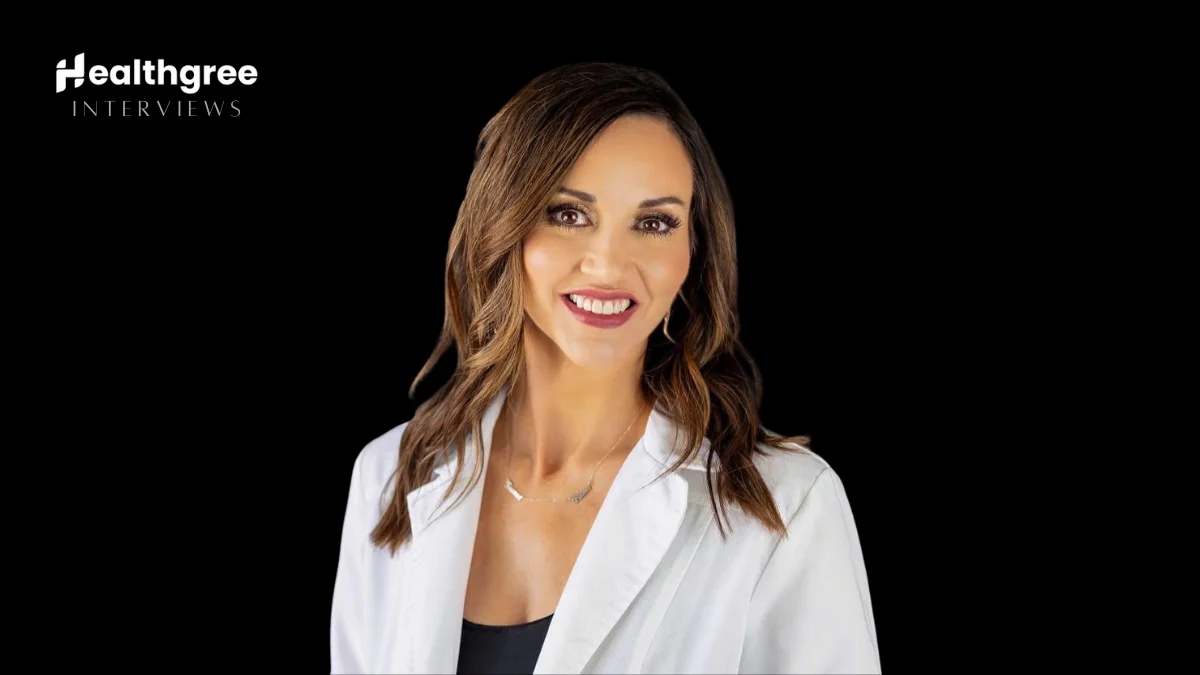

In this interview, Allison Geller, M.A., CCC-SLP, shares how she built Connected Speech Pathology from the ground up and reached her first $100K in revenue. You’ll learn how she identified unmet communication needs, grew through referrals and visibility, built systems intentionally, and scaled a private-pay telehealth practice while maintaining high standards of care and trust.
1. Please introduce yourself and the healthcare organization you lead today.
I’m Allison Geller, a speech-language pathologist and communication coach, and the founder of Connected Speech Pathology. I lead a fully remote telehealth practice that provides speech therapy and communication coaching across the lifespan, including articulation, fluency, voice, accent clarity, and professional communication. Our team works with children, teens, adults, and organizations, delivering individualized care to clients throughout the U.S. and internationally.
2. What inspired you to start or take ownership of your healthcare organization?
Connected Speech Pathology grew out of my background in medical speech-language pathology, where I worked extensively with airway, voice, and swallowing disorders in fast-paced medical settings. In that work, I saw that communication challenges rarely stemmed from a single diagnosis.
A patient’s voice, speech, cognition, emotional state, and real-world communication demands were often deeply intertwined. Many of the goals that mattered most to patients, such as functional communication, voice use in daily life, or performance-related demands, were not always supported within insurance-based models. I wanted to take ownership of a practice where care is driven by client needs rather than coverage limitations, and where personalized, real-world communication goals across the lifespan could be addressed through a flexible, telehealth-based model.
3. In the beginning, what specific patient problem were you focused on solving—and how did you confirm there was real demand for it?
Early on, I focused on clients whose communication challenges affected real-world performance but were not easily addressed within traditional care models. For children, this often meant articulation or fluency difficulties that began to interfere with classroom participation or confidence.
For teens and adults, the needs were often more functional and goal-driven, including public speaking demands, voice strain, communication-related executive functioning, and difficulty organizing and expressing ideas clearly in academic or professional settings.
Demand became evident through steady referrals and repeat inquiries from families, educators, and medical providers who were actively seeking practical, flexible services to address goals that were not well supported elsewhere.
4. What was the first service, treatment, or offering that consistently brought in revenue?
Speech therapy services for school-age children and teens, along with communication, voice, and clarity work for adults, were the first consistent revenue drivers. These services addressed common yet impactful challenges, such as articulation, fluency, voice use, and functional communication. They translated well to a telehealth model, allowing the practice to grow steadily from the start.
Related Post: How Lacey McCrary, APRN-CNP, Built BellaDerma from the Ground Up and Reached $100K/Month in 3 Months
5. How long did it take you to reach your first $100K in revenue, and what were the biggest obstacles during that period?
It took just under two years to reach the first $100K in revenue. During that time, the biggest challenge was building a business from the ground up while also managing the demands of being a working parent.
I was setting up the practice, making early business decisions, and delivering services simultaneously, often learning as I went. That period involved a steep learning curve and required balancing growth with the realities of limited time and capacity.
6. How did you attract your first 50–100 paying patients or clients?
Early patient growth came from referrals, proactive outreach, and clear communication about services. In the early stages, the practice was a solo operation, with all services delivered directly by me.
I built visibility by speaking at professional development meetings, visiting medical offices to explain my services, and connecting with providers via email and professional networks. In parallel, I developed an organic digital presence focused on education and clarity across Google search, LinkedIn, Facebook, and Instagram, supported by a website that clearly outlined our mission and services.
Together, these efforts made it easier for families, patients, and referring providers to understand what we offered and reach out.
7. How did you decide on pricing in the early days, and how did it evolve as the business grew?
Early pricing focused on accessibility within a private-pay model. Rates were set at a level that felt reasonable for families and individuals while still reflecting the value of specialized communication services.
As demand grew and the team expanded, pricing within the private-pay model increased to support sustainability and the growing need for secure systems and operational support.
Pricing also needed to reflect fair, competitive compensation for our highly trained clinicians and communication coaches, which is essential for delivering high-quality, consistent care across children, teens, and adults.
8. Which growth channel produced results first, and why do you think it worked for your business?
Referrals were the first channel to drive consistent growth, particularly in the practice’s early phase. At that stage, families and adult clients were making decisions based on trust and reassurance rather than brand recognition or marketing reach.
Recommendations from providers or colleagues reduced uncertainty and shortened the decision-making process. Early online reviews later reinforced that trust, giving new clients confidence to move forward. Together, these channels aligned well with how people seek communication services and supported steady growth before more formal marketing efforts were needed.
9. What key decision or change most accelerated your path to $100K in revenue?
A key decision that accelerated growth was becoming more involved with CORSPAN, a professional organization focused on accent modification and cross-cultural communication, and later joining its board of directors. That role exposed me to experienced corporate-focused speech-language pathologists and expanded my understanding of how communication services could extend beyond traditional clinical settings.
Separately, I pursued specialized training in accent modification, which allowed the practice to expand those services. Together, these experiences supported growth into professional and corporate communication while continuing to serve children, teens, and adults, and ultimately enabled expansion into international markets.
That period of growth was also supported by increased visibility, including being featured in The SLP Entrepreneur: The Speech-Language Pathologist’s Guide to Private Practice and Other Business Ventures, which broadened awareness of both my work and the practice.
10. What early mistakes slowed your growth or created unnecessary challenges?
One early mistake was waiting too long to formalize systems and bring in additional support. At the beginning, I managed scheduling, intake, documentation, billing, and communication manually, without established tools or workflows.
I also underestimated how much time and intention it would take to select the right platforms, such as an EMR, phone system, and billing support, and to hire, train, and build trust with the right people. That experience reinforced the importance of building infrastructure early and investing thoughtfully in both systems and team members before growth demands it.
11. When did you start thinking and operating with a true business-owner mindset, rather than only focusing on day-to-day operations?
The shift to a true business-owner mindset happened when the practice grew to the point that I could no longer spend meaningful time working directly with clients. Most of my energy was going toward scheduling, operations, and decision-making, and I felt increasingly removed from the work that mattered most to me.
That was the moment I realized the business could no longer rely on me for everything. I began building more infrastructure and hiring people to take on the many roles I had been managing myself. Finding the right support required creativity, including building a distributed team across states and internationally, which ultimately allowed the practice to operate more sustainably and intentionally.
12. How did you maintain high standards of patient care while also focusing on business growth and sustainability?
Patient care was always the priority, not something I balanced against growth. That belief guided every business decision from the start. Maintaining high standards meant knowing exactly who was delivering care under the Connected Speech Pathology name. I took a very hands-on approach to hiring, personally speaking with references, conducting multiple interviews, and running thorough background checks because trust mattered deeply to me.
If someone joined the team, they needed to provide care at the same level I would expect if I were personally taking a referral from a trusted former colleague or supervisor.
At the same time, I built operational and financial structures to support high standards of care as the practice expanded. I remained selective about client fit and slowed hiring until training and supervision standards were firmly in place. Those decisions supported responsible growth without compromising quality, ethics, or outcomes.
13. What systems, processes, or routines helped bring consistency and predictability to revenue before you reached $100K?
Before reaching $100K, consistency came from simple, repeatable ways of running the practice rather than formal systems. Referral relationships brought in a steady stream of clients, and predictability came from responding quickly to new inquiries and keeping schedules full and organized.
While each client’s care was highly individualized, I followed a consistent process for intake, goal-setting, and follow-up. I stayed in regular contact with referring providers by sharing progress updates and clearly outlining goals. Separately, I set clear expectations for clients around practice between sessions to support progress and continuity. Together, these routines helped the practice run reliably and supported steady growth before more formal systems were in place.
14. Are you currently using any AI tools or AI-powered systems in your healthcare business? If yes, in which areas are they helping you today?
Yes, we actively use AI tools across administrative and marketing functions. I regularly use AI to reduce administrative workload and improve efficiency. We also use AI-assisted tools to support our social media and marketing efforts by streamlining content creation and maintaining consistency.
For clients, we sometimes recommend AI-based tools such as Yoodli to support practice and feedback between sessions, particularly for presentation and communication work. We also use text-to-speech tools to improve accessibility for certain clients, including individuals with dyslexia or aphasia. Tools like Speechify can reinforce written material and support independence between sessions.
Importantly, AI is always positioned as a supplement to clinician-guided work, not a replacement. When used thoughtfully, these tools enhance practice opportunities, support carryover, and allow both clinicians and clients to focus more time on meaningful, high-impact work.
15. How did you fund your early growth, and what would you recommend to healthcare founders at a similar stage today?
Early growth did not require outside funding because the practice started as a lean telehealth model with minimal overhead. In the beginning, growth was supported organically through referrals and revenue generated directly from services rather than loans or outside capital. As demand increased, particularly following the broader adoption of telehealth after COVID, revenue was reinvested into the business to support expansion.
That included hiring team members and investing in the systems and platforms needed to operate at a higher level.
For healthcare founders, my recommendation is to start lean when possible, validate demand first, and reinvest thoughtfully as growth requires additional infrastructure rather than taking on unnecessary financial risk early on.
16. What advice would you give to doctors, founders, or healthcare owners who want to start a new healthcare business or scale an existing one?
Building a healthcare business is a lot of work. It requires an enormous amount of time, organization, and follow-through, often far beyond clinical responsibilities alone. My advice is to be very honest with yourself about the commitment involved and to build strong systems early, because that’s what allows you to protect patient care while the business grows.