

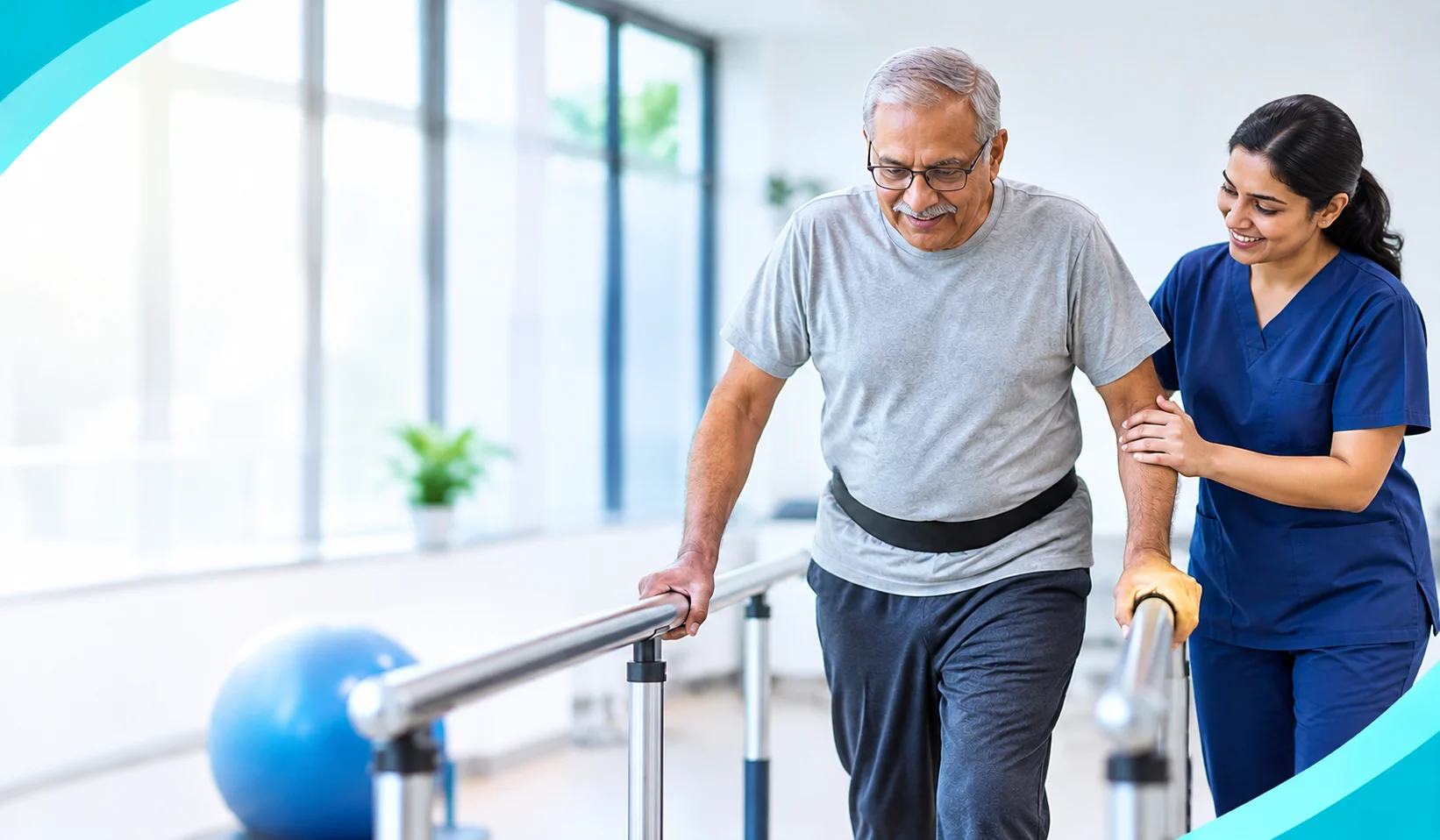

When someone has a stroke, walking across a room can suddenly become a difficult task. A person who previously moved around independently may now need help sitting, standing, or taking a few steps.
For families, one question becomes especially important: How long will it take to walk again?
Some stroke survivors regain walking ability within days or weeks. Others need months of rehabilitation, while people with severe movement difficulties may require long-term assistance.
There is no fixed recovery timeline. Progress depends on the stroke’s severity, the person’s balance and movement control, overall health, and rehabilitation needs. Physiotherapy can support walking recovery, but it cannot guarantee that everyone will walk independently.
This guide explains what patients and caregivers can expect, how physiotherapy helps, and what to consider during recovery.
Can a Stroke Patient Walk Again?
Yes, many stroke survivors regain some walking ability, although the amount of recovery varies.
A stroke damages part of the brain through interrupted blood flow or bleeding. Depending on the affected area, it may cause weakness, paralysis, reduced sensation, muscle stiffness, or difficulty coordinating movements.
Some people eventually walk without assistance. Others may need a walker, walking stick, ankle support, or help from another person.
Recovery is not limited to walking independently. Being able to stand more safely, move between a bed and chair, or walk with less assistance can also make everyday life easier.
How Long Does Walking Recovery Take?
The first three months are often an important period for improvement, but recovery can continue beyond this stage.
First Few Days to Weeks
Rehabilitation may begin once the patient is medically stable and the treating team considers it appropriate.
Early activities might involve changing positions in bed, maintaining sitting balance, or practising supported standing. Patients with milder movement difficulties may begin walking sooner than those with more extensive weakness.
One to Three Months
Some patients experience substantial improvement in movement and balance during this period.
Depending on their abilities, physiotherapy may involve standing, stepping, and walking with suitable assistance. Patients who can already walk may work on reducing support or increasing distance.
Three to Six Months
Rehabilitation may increasingly focus on walking endurance, stability, turning, and managing everyday environments.
Patients may practise walking over different surfaces or using stairs when their balance and physical abilities make these activities appropriate.
After Six Months
Recovery does not automatically stop at six months. Some patients continue improving with rehabilitation months or years after the stroke.
Progress may become slower, and independent walking may not be achievable for everyone. The focus should remain on safe, meaningful improvements rather than a promised recovery date.
Why Can Someone Move Their Leg but Still Struggle to Walk?
Families sometimes notice that a stroke survivor can lift a leg while lying in bed but cannot stand or walk safely.
This happens because walking involves more than muscle strength.
The brain must coordinate balance, posture, foot placement, weight transfer, and movement timing. A stroke may interfere with these abilities even when some leg movement remains.
For example, a person may be able to bend their knee while sitting but struggle to support body weight on that leg.
Physiotherapy therefore addresses several movement skills together instead of focusing only on strengthening exercises.
What Affects Walking Recovery After Stroke?
Two people with similar stroke diagnoses may have very different rehabilitation needs.
Several factors can influence progress:
- Stroke severity: More extensive neurological injury may cause greater movement difficulties.
- Early movement ability: Leg control and sitting balance can help clinicians assess recovery potential.
- Muscle stiffness: Unusual tightness or involuntary muscle activity can interfere with movement.
- Sensation and coordination: Difficulty sensing limb position may affect stepping and balance.
- Overall health: Fatigue, pain, and associated medical conditions may limit activity.
- Rehabilitation participation: Appropriate, repeated practice helps patients develop movement skills.
These factors help guide rehabilitation planning, but they cannot predict an exact date for walking independently.
What Happens During the First Physiotherapy Assessment?
The first appointment is about understanding the patient’s current abilities and limitations.
A physiotherapist may review medical history, examine leg movement, assess sitting and standing balance, and check whether the patient can move safely between surfaces.
The assessment may include:
- Strength and movement control in the affected leg
- Ability to sit or stand with appropriate support
- Muscle stiffness, joint movement, and sensation
- Balance difficulties and fall risk
- Assistance needed for transfers or walking
The findings help determine suitable rehabilitation goals.
For one patient, the immediate priority may be sitting without support. Another may be ready to practise standing or walking with assistance.
How Does Physiotherapy Help Someone Walk Again?
Physiotherapy helps stroke survivors practise movements that are important for daily mobility.
Treatment may begin with activities that improve upper-body stability, supported standing, and control of the affected leg. As abilities improve, rehabilitation can progress toward stepping and walking practice.
Common approaches include:
- Strengthening exercises: Developing muscle capacity needed for standing and walking.
- Balance training: Improving stability while sitting, standing, or moving.
- Sit-to-stand practice: Training the movement used when getting up from a chair.
- Weight-shifting exercises: Learning to move body weight safely between the legs.
- Gait training: Practising how to step and walk with suitable assistance.
- Endurance training: Gradually increasing tolerance for physical activity.
Some patients may benefit from walking aids, ankle supports, parallel bars, or other rehabilitation equipment.
The purpose of treatment is to improve practical movement, not simply to complete a set of exercises.
What Does Walking Rehabilitation Look Like?
Consider a hypothetical 58-year-old stroke survivor who initially needs help sitting at the edge of a bed.
Early rehabilitation might focus on keeping the upper body steady. Once sitting becomes safer, the patient may begin practising supported standing and controlled movement between the legs.
Later sessions could involve assisted stepping and walking short distances with a suitable aid.
As abilities change, the physiotherapist may adjust the treatment plan.
This example illustrates a possible rehabilitation journey, not a guaranteed sequence or recovery timeline.
How Often Should a Stroke Patient Receive Physiotherapy?

There is no single schedule suitable for every stroke survivor.
Some patients may benefit from frequent rehabilitation, particularly during the early recovery period. Others need a different approach because of fatigue, medical conditions, or physical limitations.
The rehabilitation team should consider the patient’s goals, ability to tolerate activity, and response to treatment when recommending therapy frequency.
Home exercises may support progress, but they should follow professional guidance.
There is no universal number of daily steps, walking minutes, or exercise repetitions that is safe for every stroke patient. Walking practice should be adjusted according to balance, fatigue, symptoms, and fall risk.
What Problems Can Make Walking Difficult?
Even when leg strength improves, other difficulties may continue affecting mobility.
Foot drop can make it difficult to lift the front of the foot, increasing the risk of tripping. Spasticity causes unusual muscle tightness or stiffness that may interfere with movement.
Some patients experience significant fatigue, poor balance, or reduced awareness of one side of the body. Others become afraid of falling after an earlier incident.
These problems require individual assessment. Simply increasing exercise repetitions may not address the underlying difficulty.
Can Someone Walk Again After Severe Paralysis?
Severe paralysis can make walking recovery more challenging, but outcomes vary.
Some patients gradually regain enough movement for assisted walking. Others may continue needing mobility aids or a wheelchair.
Rehabilitation may still help improve sitting balance, joint movement, standing tolerance, and the ability to transfer between surfaces.
For someone with severe limitations, moving from a bed to a chair with less assistance may be an important step toward greater independence.
What If Walking Has Not Returned After Six Months?
Not walking independently after six months does not automatically mean rehabilitation can no longer help.
A physiotherapist may reassess strength, balance, muscle stiffness, endurance, and the suitability of mobility aids.
The treatment plan can then focus on realistic goals, such as standing more safely, reducing assistance during transfers, or improving walking with appropriate support.
Recovery should be measured against the person’s earlier abilities rather than another patient’s progress.
How Can Families Support Walking Recovery at Home?
Family members can help patients follow rehabilitation recommendations and make their surroundings safer.
Useful precautions include:
- Keep walking areas free from loose rugs and obstacles.
- Use prescribed mobility aids correctly.
- Follow the physiotherapist’s home exercise instructions.
- Allow appropriate rest when fatigue increases.
- Learn safe methods for assisting with standing and transfers.
- Report falls, new pain, or changes in movement ability.
Do not force a patient to walk before they are ready. Pulling the affected arm or attempting unsupported transfers can also cause injury.
How Can Patients Recognize Progress?
Walking recovery is not measured only by distance.
A patient may be improving when they can sit more steadily, rise from a chair with less help, take more controlled steps, or walk with better balance.
Physiotherapists may assess walking speed, distance, endurance, balance, and the amount of assistance required.
Small improvements can be meaningful when they make daily activities safer or easier.
When Should You Seek Emergency Medical Help?
Sudden facial drooping, new arm or leg weakness, difficulty speaking, vision changes, or severe balance problems may indicate another stroke.
A sudden severe headache can also require emergency assessment.
Seek emergency medical assistance immediately if these symptoms occur. In India, the national emergency number is 112.
How to Choose a Stroke Rehabilitation Centre
When searching for a Physiotherapy centre in Patna, patients and families should consider whether the facility provides neurological assessment, individualized treatment planning, supervised walking practice, and regular progress monitoring.
It is also useful to ask whether caregivers receive home-care guidance and how the rehabilitation team coordinates with other medical professionals.
A suitable rehabilitation program should explain treatment goals clearly without promising recovery within a fixed period.
Conclusion
Walking recovery after stroke is different for every person. Some regain mobility relatively quickly, while others need months of rehabilitation or ongoing assistance.
Physiotherapy helps patients work on strength, balance, coordination, and practical movement skills. Progress may begin with sitting or standing more safely before walking becomes possible.
The most important goal is not reaching a fixed recovery deadline. It is achieving the safest and most meaningful level of mobility and independence possible.
Frequently Asked Questions
Can an elderly stroke patient learn to walk again?
Yes, some older adults regain walking ability after stroke. Age alone does not determine the outcome. Overall health, stroke severity, balance, and rehabilitation needs also matter.
Is physiotherapy helpful one year after a stroke?
It can be. Rehabilitation may still help improve specific movement abilities, balance, or daily mobility long after the initial stroke.
Can a stroke patient recover walking ability without physiotherapy?
Some natural neurological recovery may occur, especially during the early months. Structured rehabilitation provides opportunities to practise movement and address functional difficulties.
Is walking with a walker considered successful recovery?
It can represent meaningful improvement. If a walker allows someone to move more safely and participate in everyday activities, it may support greater independence.
When is a stroke patient ready to start walking practice?
Readiness depends on medical stability, movement control, balance, strength, and the assistance required. A qualified rehabilitation professional should assess these factors before walking practice begins.